YouTube RPM vs CPM : le calcul trop souvent ignoré de ce que les créateurs gardent vraiment
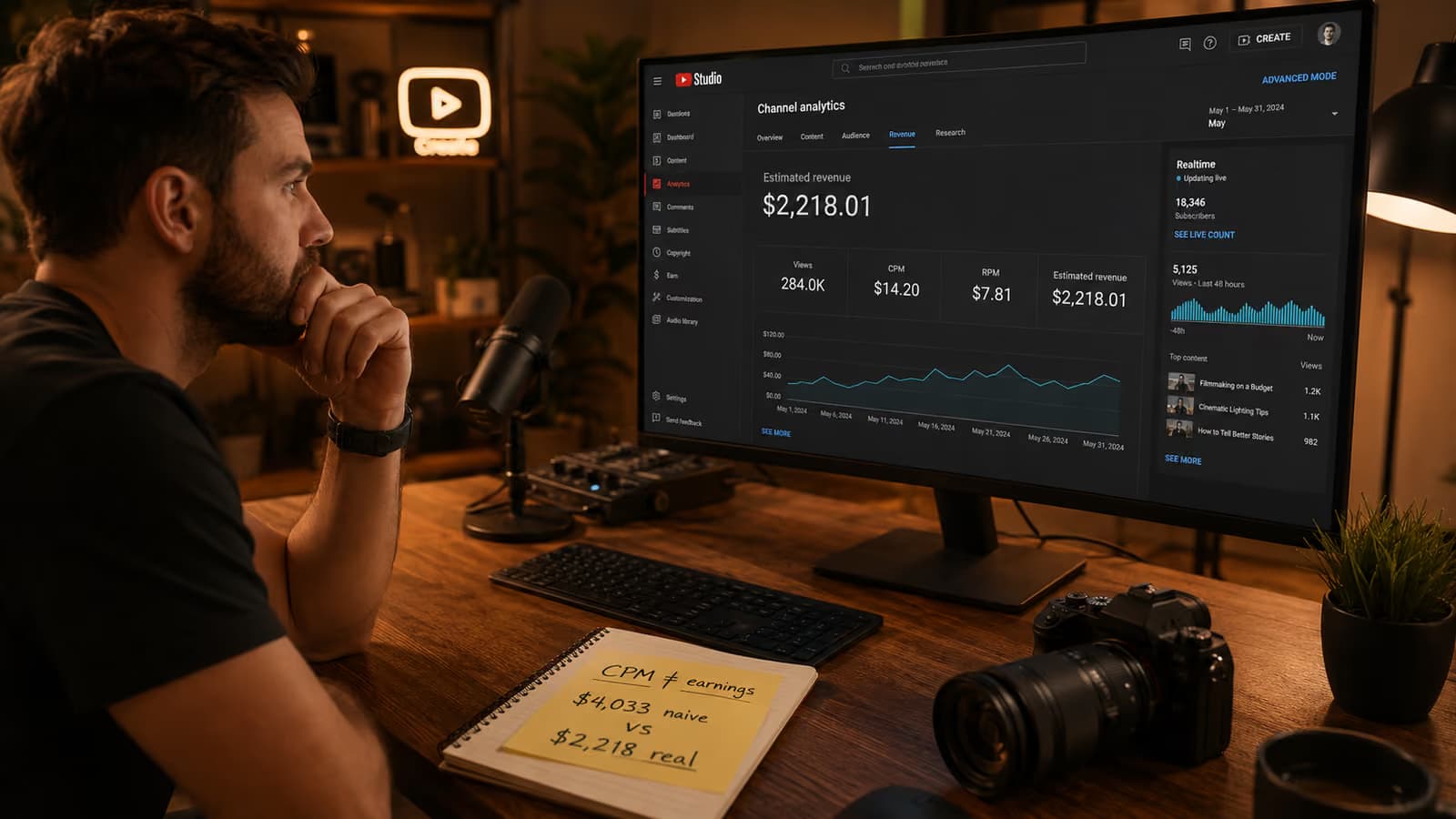
CPM vs RPM sur YouTube : la confusion qui coûte des milliers aux créateurs
Le mois dernier, Emma — une créatrice à 67 000 abonnés — a fêté son premier CPM à 10 $. Elle a multiplié ses vues de janvier par 10 $ et annoncé 4 800 $ de gains.
Ses vrais revenus ? 2 640 $.
Elle avait calculé avec le CPM au lieu du RPM. Cet écart de 2 160 $ a failli la faire tout arrêter, convaincue d’avoir été arnaquée.
Cette confusion détruit plus de rêves de créateurs que du mauvais contenu. Le CPM, c’est ce que les annonceurs paient à YouTube. Le RPM, c’est ce que YouTube vous paie. L’écart est énorme, non négociable, et c’est le point le plus important à comprendre sur la monétisation pub YouTube.
Définitions claires : ce que chaque métrique veut vraiment dire
CPM (Cost Per Mille) : ce que les annonceurs paient à YouTube pour 1 000 impressions pub. Une impression est comptée chaque fois qu’une pub s’affiche. C’est le langage de la pub — utile pour comparer les plateformes ou mesurer la valeur de votre audience pour les marques.
RPM (Revenue Per Mille) : ce que vous gagnez réellement pour 1 000 vues vidéo, après la commission YouTube et d’autres facteurs. Il inclut les pubs, les abonnements de chaîne, YouTube Premium, Super Chat, Super Stickers, etc. Pour les Shorts, le RPM se calcule pour 1 000 vues engagées.
La relation de base pour le revenu pub long format est simple :
RPM ≈ CPM × 0,55
YouTube garde environ 45 %. Les créateurs reçoivent 55 %. Ce split est standard, quelle que soit la taille de chaîne.
Le playback-based CPM est un troisième chiffre qui embrouille souvent. Il mesure le coût annonceur pour 1 000 lectures vidéo où une pub est apparue (peu importe le nombre de pubs). Il est en général 30–50 % plus bas que le CPM classique, parce que toutes les vues ne génèrent pas une pub. La plupart des créateurs peuvent l’ignorer et se concentrer sur le CPM standard (signal de demande) et le RPM (vrai revenu).
Autres métriques liées dans YouTube Analytics :
- Vues : nombre de fois où la vidéo a été regardée.
- Impressions pub : fois où des pubs individuelles ont été montrées.
- Lectures monétisées estimées : fois où la vidéo a été regardée avec au moins une pub.
- Revenu estimé : total toutes sources (pubs + abonnements + Premium + Super Chat, etc.).
- Revenu pub estimé : pubs uniquement.
Toutes les vues ne se monétisent pas. Raisons : viewers YouTube Premium, bloqueurs de pubs, aucune pub disponible qui matche le ciblage, contenu non advertiser-friendly, facteurs géo / dispo. D’où plus de vues que de lectures monétisées — et un RPM presque toujours plus bas qu’un calcul CPM naïf.
Pourquoi YouTube affiche les deux
Le CPM aide les annonceurs à comparer les coûts entre plateformes (YouTube vs le reste). Un CPM élevé signale une forte demande pour votre audience. Le RPM existe pour votre compte en banque. C’est le chiffre à multiplier par les vues pour projeter le vrai revenu, et celui à suivre mois après mois.
Exemple d’analytics réels :
- 284 000 vues
- CPM 14,20 $ → un calcul naïf suggère ~4 033 $
- RPM réel 7,81 $ → vrais gains ~2 218 $
L’écart est normal. Utiliser la mauvaise métrique pour planifier les finances mène souvent à une surestimation d’environ 80 %.
Vrais patterns CPM → RPM par niche
Les dashboards de centaines de créateurs montrent que le ratio varie un peu selon la niche (charge pub, rétention, comportement d’audience), mais la relation ~55 % tient :
| Niche | CPM moy. | RPM moy. | Ratio approx. | | --- | --- | --- | --- | | Finance / investissement | 18,40 $ | 8,57 $ | ~2,15× | | Assurance / juridique | 16,20 $ | 7,95 $ | ~2,04× | | Business / SaaS | 14,80 $ | 7,22 $ | ~2,05× | | Reviews tech | 12,60 $ | 6,93 $ | ~1,82× | | Éducation | 10,20 $ | 5,10 $ | ~2,00× | | Santé / fitness | 9,40 $ | 4,88 $ | ~1,93× | | Lifestyle / vlogs | 5,80 $ | 3,02 $ | ~1,92× | | Comédie | 4,40 $ | 2,29 $ | ~1,92× | | Gaming | 3,60 $ | 1,98 $ | ~1,82× |
Le même volume de vues mensuel peut produire des gains très différents rien qu’à cause de ça. Une chaîne finance à 100k vues peut gagner ~857 $ ; une chaîne gaming au même volume ~198 $.
Où trouver vos chiffres
Dans YouTube Studio → Analytics → onglet Revenu, vous verrez RPM, CPM, revenu estimé et métriques liées. Prenez au moins une fenêtre de 28 jours pour des tendances stables. Les chiffres d’un jour ou d’une courte période bougent trop. Suivez le RPM le 1er de chaque mois pour voir les vrais changements.
Pourquoi le RPM est le seul chiffre qui compte pour le revenu
La formule des gains pub mensuels :
Gains mensuels = (Vues totales × RPM) ÷ 1 000
Le CPM n’apparaît pas dans cette équation. Vous ne contrôlez pas directement les enchères annonceurs, mais vous pouvez influencer le RPM via ce que vous contrôlez.
Erreurs fréquentes :
- Calculer le revenu avec le CPM au lieu du RPM
- Comparer des CPM entre niches sans contexte
- Ignorer les tendances RPM mois après mois
- Fixer des objectifs autour du CPM plutôt que du revenu ou du RPM
- Pivoter vers des sujets high-CPM qu’on ne maîtrise pas (les vues baissent souvent assez pour annuler le gain)
Comment relever le RPM sans forcément relever le CPM
- Passer les vidéos au-delà de 8 minutes (idéalement 10–15) pour débloquer plusieurs mid-rolls.
- Améliorer la durée moyenne de visionnage et la rétention pour que plus de pubs soient vues.
- Uploader dans les fenêtres de plus forte demande (souvent les heures de bureau US, mardi–jeudi).
- Optimiser pour des géographies plus valorisées (US, UK, Canada, Australie, etc.) via le sujet, la langue et le timing — le trafic tier-1 compose à la fois les enchères et les taux de monétisation.
Ces leviers structurels relèvent souvent le RPM de 30–50 % même si le CPM reste relativement plat.

Shorts et autres flux de revenus
Le RPM Shorts est bien plus bas (souvent 0,05–0,15 $ dans beaucoup de rapports) parce que le revenu vient d’un fonds mutualisé, pas de pubs directes par vidéo. Traitez les Shorts surtout comme un outil de découverte et de croissance qui alimente du long format à RPM plus élevé.
La pub n’est qu’une pièce. Beaucoup de créateurs gagnent désormais plus via sponsoring, affiliation, abonnements, produits digitaux et autres flux que via AdSense seul. Pour ceux qui construisent encore leur audience, ou qui cherchent un revenu au résultat sans seuils d’abonnés élevés, des plateformes comme Wayo Ads offrent une autre voie — paiement sur des vues ou clics validés, conditions transparentes, pas de minimum de followers.
En résumé
Deux chiffres à retenir :
- Le RPM est la seule métrique qui détermine directement votre revenu pub.
- Le RPM vaut environ 55 % du CPM pour les pubs long format standard, parce que YouTube garde 45 %.
Vous ne changez pas la commission plateforme ni les enchères du jour au lendemain. Vous pouvez structurer les vidéos, améliorer la rétention, timer les uploads et viser des audiences plus fortes pour qu’une plus grande part du revenu disponible vous atteigne. Suivez le RPM, optimisez ce que vous contrôlez, et traitez AdSense comme une fondation parmi plusieurs flux. C’est ce qui transforme des analytics confus en chemin vers un revenu durable.
Des outils qui récompensent l’attention validée — comme ceux disponibles via Wayo Ads — peuvent s’ajouter à cette fondation.
Sources
- Understanding YouTube CPM and RPM (TubeAnalytics)
- Understand ad revenue analytics (YouTube Help)
- YouTube RPM vs CPM (YT Money Calculator)
Sources et ressources
Documentation officielle, études et sources à forte autorité (SEO / recherche) :