Beyond AdSense: Real YouTube Monetization Benchmarks Across Channel Sizes
How Much Does YouTube Really Pay—and Why Creators Are Building Income Beyond AdSense
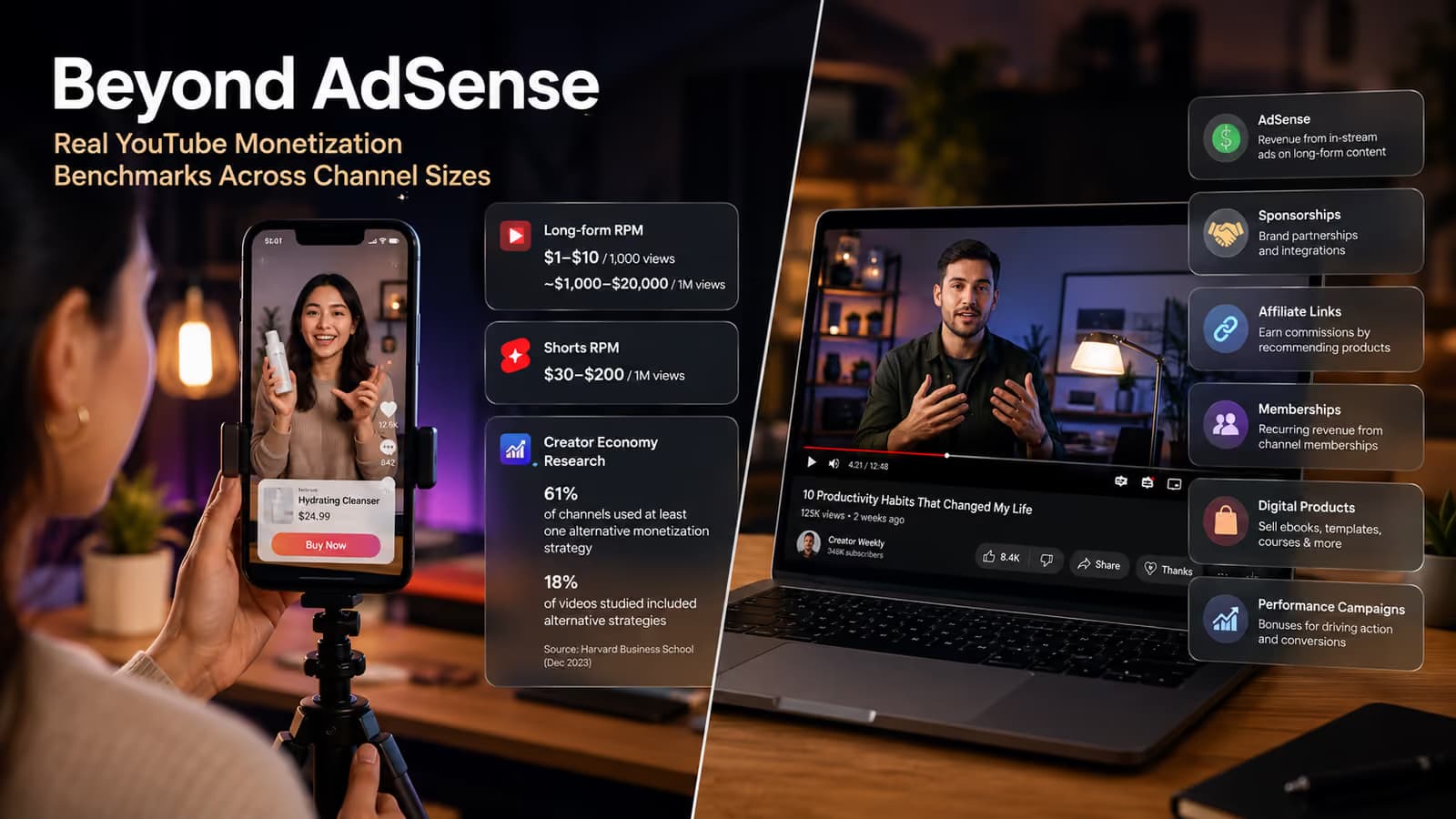
YouTube does not pay creators a fixed rate per view. Earnings depend on RPM (revenue per thousand views), which varies by niche, audience location, watch time, ad engagement, and whether views are monetized. Most creators earn roughly $1–$10 per 1,000 views on long-form content, which can translate to $1,000–$20,000 per million views depending on the topic. Shorts typically pay far less—often $30–$200 per million views. Beyond YouTube’s own tools, many creators rely on alternative monetization strategies that route money directly from audiences or brands.
This mix of platform revenue and off-platform methods shapes real creator incomes. A growing body of research shows just how widespread those alternatives have become—and why they matter for both everyday creators and the platform’s gatekeeping role.
How YouTube Monetization Actually Works
YouTube pays creators primarily through the YouTube Partner Program (YPP) once they meet thresholds: 1,000 subscribers plus 4,000 public watch hours in the past 12 months, or 10 million Shorts views in 90 days. Eligible creators earn from:
- Advertising revenue (pre-roll, mid-roll, display ads)
- YouTube Premium shares
- Channel memberships
- Super Chat, Super Stickers, and Super Thanks
- YouTube Shopping affiliate commissions
Two key metrics drive the numbers:
- CPM (Cost Per Mille): What advertisers pay YouTube per 1,000 ad impressions (often $1–$30+).
- RPM (Revenue Per Mille): What the creator actually receives per 1,000 views after YouTube’s cut (typically ~45%), unmonetized views, ad blockers, and regional differences. Typical long-form RPMs sit between $0.50 and $10+.
A simple estimate is: Earnings ≈ RPM × (Views ÷ 1,000).
Typical long-form RPM ranges by niche (approximate 2025 figures):
- Personal Finance: $4–$20
- Tech & Productivity: $3–$12
- Business & Marketing: $4–$15
- Education/How-to: $2–$8
- Fitness & Wellness: $2–$7
- Beauty & Fashion: $1.50–$6
- Entertainment & Vlogs: $0.50–$4
- Gaming: $0.50–$3
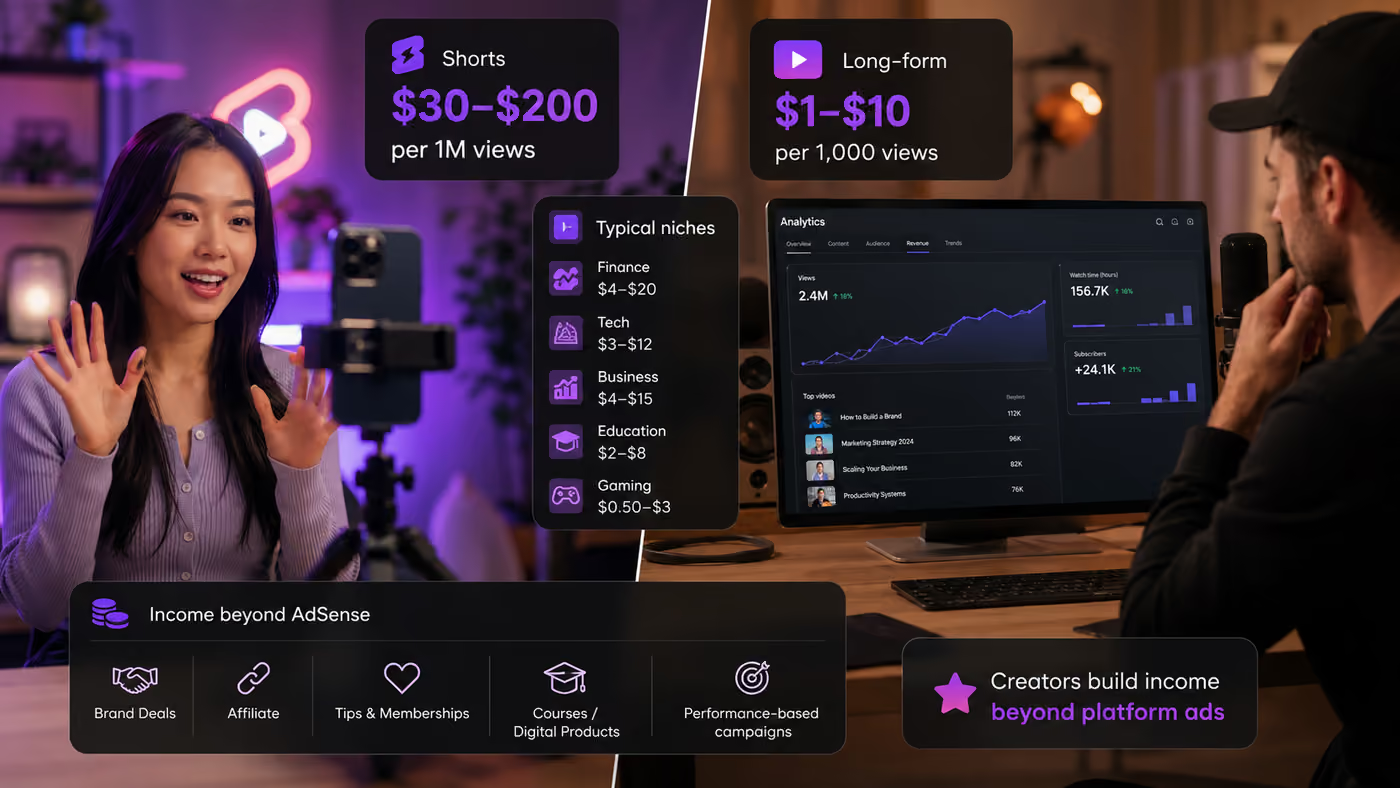
For 1 million views, that produces roughly $1,000–$20,000 on the high end for finance or tech, versus $800–$3,000 for gaming or entertainment. Shorts use a pooled ad model (ads between videos in the feed), so payouts are lower and more variable.
Audience location matters heavily—views from the US, Canada, UK, Australia, and Western Europe command higher rates. Longer videos allow more mid-rolls, higher retention improves fill rates, and search/suggested traffic often monetizes better than external embeds. Seasonality (stronger in Q4) and content category policies also play roles.
Subscribers and engagement do not pay directly, but they drive consistent views, better retention, more ad inventory, and stronger algorithmic reach—indirectly lifting RPM and brand appeal.
The Rise of Alternative Monetization Strategies
AdSense is rarely the whole story. Creators routinely use the video description box and other affordances to point audiences toward external income streams. A large-scale study of popular YouTube channels (over 71 million videos from 136,000+ channels) mapped these “alternative monetization strategies” into four main categories:
- Direct donations / support – Links to Patreon, PayPal, Ko-fi, etc.
- Affiliate marketing – Tracking links to products or services.
- Sales of channel-related products or services – Merch, digital products, courses, coaching.
- Cryptocurrency donations – Wallet addresses or crypto payment pages.
Key findings from the research:
- Alternative strategies appeared in 18% of all videos studied; 61% of channels used at least one at some point.
- Adoption has grown sharply over time (e.g., donation links rose from ~2.7% of channels in 2008 to around 20% by 2018). Affiliate marketing and donation requests dominate.
- Usage is uneven: more popular channels adopt them more often, and strategies align with content type (e.g., “How to & Style” channels lean heavily on affiliates).
- Channels that begin using these methods tend to become more productive—content output rose about 43% on average in the first year after adoption.
- Creators of potentially problematic content (Alt-lite, Alt-right, Manosphere communities previously studied in the literature) used a more diverse set of these strategies significantly more often than matched comparison channels. This complicates YouTube’s demonetization efforts: excluding content from on-platform ads does not necessarily remove financial incentives if off-platform options remain available.
In short, creators treat YouTube as a distribution engine and build parallel revenue rails. This can support higher-quality or more niche work that might not maximize pure view volume, but it can also sustain content that the platform itself restricts.
Stacking Income Streams in Practice
Most successful creators treat AdSense as a foundation and layer additional methods:
- Brand deals / sponsorships – Rates scale with average views and niche relevance (hundreds to tens of thousands of dollars per video).
- Affiliate marketing – Commissions on recommended products.
- Memberships, Super Chats, and direct tips.
- Digital products and services – eBooks, templates, courses, coaching sold via a storefront.
- Newer performance-based platforms that pay for validated views or clicks without high subscriber thresholds.
For creators still building an audience or facing low RPMs, platforms designed specifically for smaller channels can fill gaps. One example is Wayo Ads, a marketplace that connects brands with creators through performance-based campaigns (fixed CPM on validated video/Shorts views or CPC on links). It requires no minimum followers, takes a transparent ~5% platform fee (creators keep ~95%), and focuses on genuine engagement rather than raw follower counts. It is especially relevant for YouTube creators who want additional pay-per-view style income alongside or before full YPP eligibility.
Practical Levers to Raise Earnings
You cannot control every algorithm change, but you can influence the variables that move RPM and total income:
- Choose or lean into higher-CPM topics when it aligns with genuine expertise (finance, business, tech, career skills).
- Improve retention and average view duration—strong openings, tight editing, pattern breaks, clear structure, and chapters all help.
- Publish consistently and study analytics (highest-RPM videos, drop-off points, thumbnail/title CTR).
- Diversify early: affiliates, digital products, memberships, and carefully chosen performance platforms reduce reliance on any single revenue source.
- Treat Shorts primarily as discovery tools that feed long-form content, which still pays substantially more.
YouTube’s pay structure feels unpredictable until you understand the interplay of RPM, niche, audience, and the growing ecosystem of alternative strategies. The research is clear: external monetization is already common, increasingly so, and linked to higher output. For creators, the practical takeaway is straightforward—optimize for platform revenue where possible, then deliberately build additional streams so income does not depend solely on ad auctions or policy decisions.
Whether you are still chasing the YPP thresholds or already monetized, the creators who treat YouTube as one (powerful) distribution channel among several tend to build more resilient businesses. Exploring tools that reward validated attention—such as those available through Wayo Ads—can be one natural next step in that process.
Sources
Source & Resources
Official documentation, research, and high-authority sources: