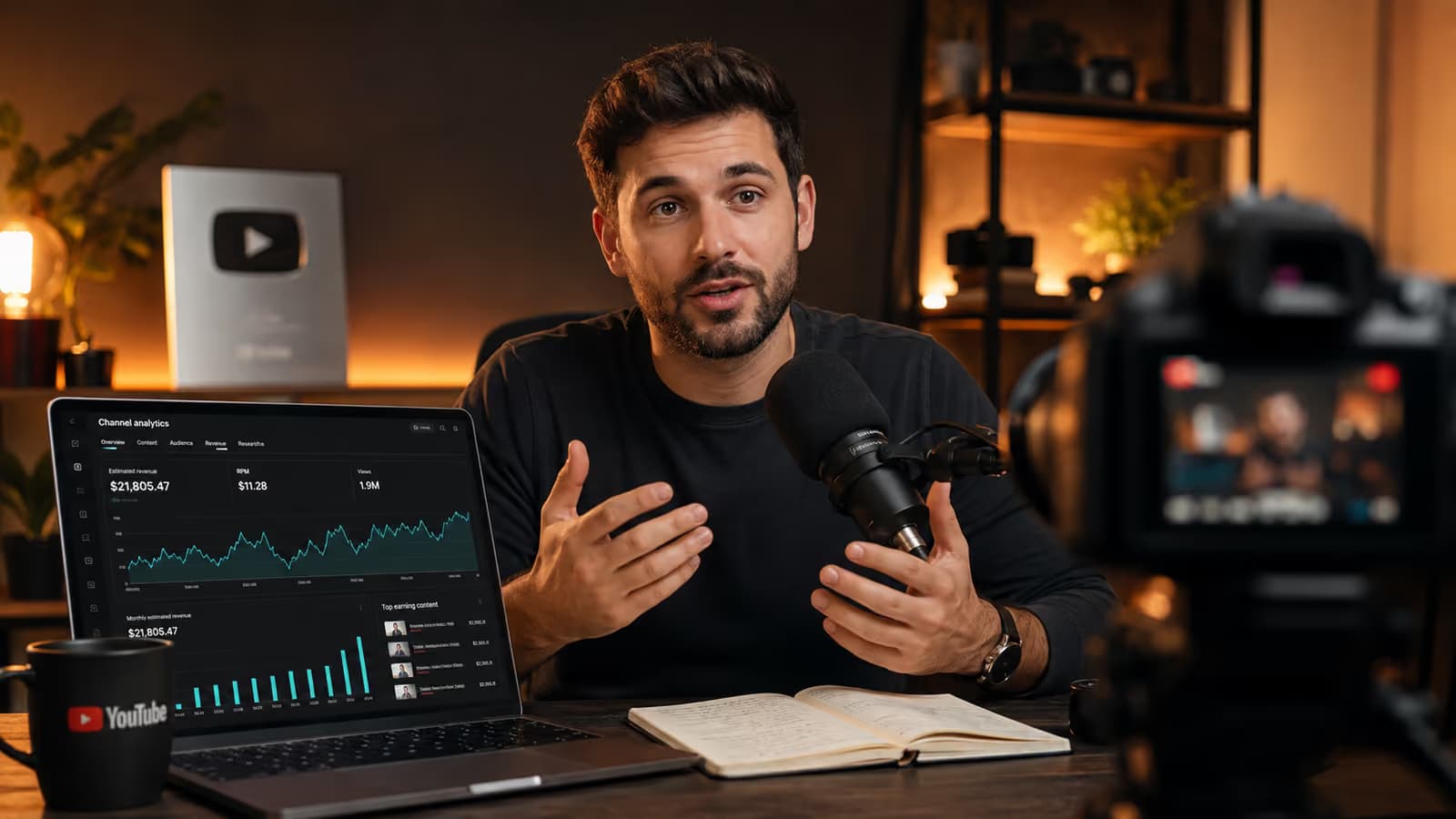
How Much Do YouTubers Actually Make in 2026? (Real Ranges, Not Vague Averages)
Almost every article on YouTube monetization gives a range so wide it’s useless: “$1 to $30 per thousand views.” That’s like asking how much a car costs and hearing “somewhere between $5,000 and $500,000.”
The truth is simpler and more useful. YouTube does not pay a flat rate. There is no secret spreadsheet at Google that says “1,000 views = $X.” Earnings depend on interconnected factors—niche, audience location, video length, retention, content format, and how you stack additional income streams. Understanding those factors is far more valuable than memorizing an average.
After reviewing creator reports, revenue screenshots, and platform data, here’s what actually shows up in YouTube Studio dashboards in 2026—and how smarter creators turn those numbers into real income.
The Real Ranges Creators Report
For long-form content, most monetized creators see $1–$10 RPM (Revenue Per Mille—what lands in your pocket after YouTube’s cut). That range hides huge variation:
- Retro gaming or entertainment essays: often around $4–$6.50
- Business / product design: roughly $4.50–$8
- Finance, tech, software, and specialized B2B: frequently $15–$25, with some clearing $30+
YouTube’s official split gives creators 55% of ad revenue generated. In practice, effective rates on total views are often lower because of ad blockers (used by a large share of viewers), non-monetized impressions, and filtered invalid traffic.
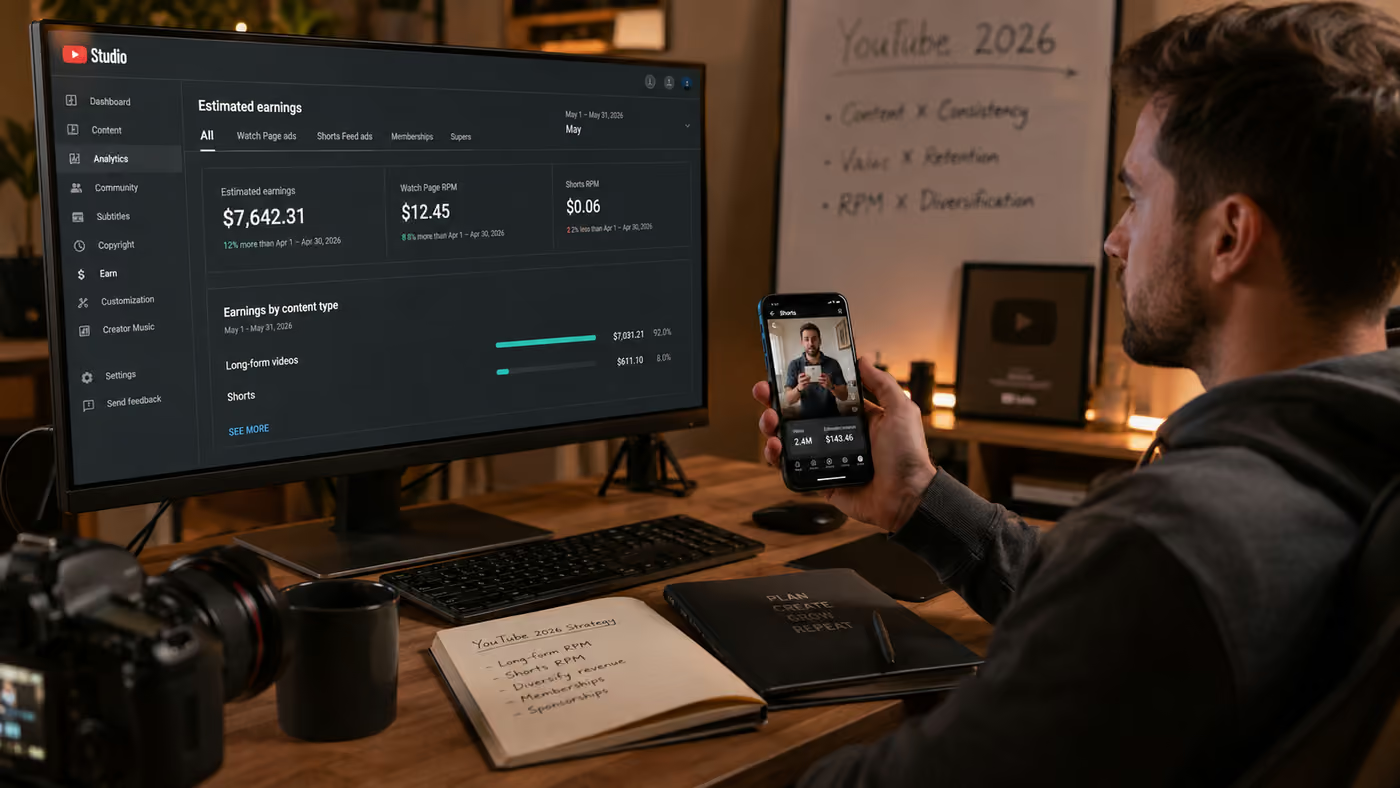
YouTube Shorts operate on a completely different scale. Creators commonly report $0.01–$0.07 per 1,000 views (sometimes as low as $0.03–$0.20 RPM in better cases). A million Shorts views might net $30–$70 (or a few hundred in strong niches). The same million views on a solid long-form video can produce $2,000–$6,000 or more.
Why the gap? Long-form videos allow direct pre-roll, mid-roll, and post-roll ads. Shorts share a pooled ad revenue stream (ads shown between videos in the feed), minus music licensing costs, then split among creators based on their share of total views.
Why Niche and Geography Decide Almost Everything
Advertisers bid very differently depending on the audience. A company selling enterprise software will pay far more to reach a decision-maker than a mobile game will pay for teenage downloads. This is why identical view counts produce completely different paychecks.
Typical long-form RPM ranges by niche:
| Niche | Typical RPM | Approx. per 1M views | | --- | --- | --- | | Finance / Investing | $10–$30+ | $10,000–$30,000+ | | Business / Marketing | $8–$20 | $8,000–$20,000 | | Technology / Software / AI | $6–$15+ | $6,000–$15,000+ | | Education | $4–$10 | $4,000–$10,000 | | Tech Reviews / Gadgets | $5–$15 | $5,000–$15,000 | | Gaming | $1–$4 | $1,000–$4,000 | | Entertainment / Vlogs | $1–$3 | $1,000–$3,000 | | Music | $0.50–$2 | $500–$2,000 |
A gaming channel often needs roughly 10× the views of a personal-finance channel to earn the same amount. Choosing a niche is a business decision, not just a creative one. You can succeed in lower-CPM categories, but you must play the volume game—or carve out a smaller, high-value audience.
Geography amplifies this. A thousand views from the United States, Canada, United Kingdom, Australia, Germany, or Nordic countries are typically worth 3–5× more than the same views from lower-ad-spend regions. English-language creators who deliberately target premium markets (through topics, keywords, and upload timing) usually see higher RPMs than those producing purely global general-interest content. RPMs also rise in Q4 as advertisers increase holiday budgets.
Video Length, Mid-Rolls, and Retention
Videos under 8 minutes can only run pre-roll and post-roll ads. Crossing 8 minutes unlocks mid-roll placements. More ad opportunities generally mean higher revenue per view—provided viewers stay. Many creators report that simply extending videos (without other changes) meaningfully lifted RPM.
The practical sweet spot for most is 10–15 minutes: long enough for multiple mid-rolls, short enough to protect retention. Place ads at natural transitions so they don’t drive viewers away. Strong average view duration often outperforms raw view volume for earnings.
What Real View Counts Actually Earn
Illustrative examples based on current creator reports:
100,000 views
- Entertainment ($2 RPM) ≈ $200
- Tech review ($6 RPM) ≈ $600
- Finance ($15 RPM) ≈ $1,500
1 million views
- General content ($3 RPM) ≈ $3,000
- Education ($5 RPM) ≈ $5,000
- Business / investing ($20 RPM) ≈ $20,000
10 million views
- Gaming ($2 RPM) ≈ $20,000
- Technology ($8 RPM) ≈ $80,000
- Finance ($25 RPM) ≈ $250,000
These are not guarantees. They show how niche selection compounds at scale.
Subscriber Count Is Misleading
A channel with 50,000 highly engaged subscribers in a high-RPM niche can easily out-earn one with 500,000 subscribers driven mostly by Shorts or low-value traffic. Views, watch time, audience quality, and monetization mix matter far more than the subscriber number.
Rough benchmarks by stage:
- 1,000–10,000 subscribers: Often $20–$1,000/month from ads once monetized. Many lean on affiliates, small sponsorships, and direct support first.
- 10,000–100,000: Frequently $1,000–$5,000+/month as sponsorships become more consistent and creators add memberships or digital products.
- 100,000–1 million: AdSense can reach $5,000–$50,000+/month; diversified streams (merch, courses, recurring deals) often dominate.
- 1 million+: Many operate like media companies. Ad revenue is substantial, but the biggest earnings usually come from brands, owned products, licensing, and commerce (MrBeast being the clearest example).
Shorts accelerate subscriber growth but rarely deliver proportional ad income. The smart pattern is using Shorts for discovery and funneling viewers into longer, higher-RPM videos.
Beyond AdSense: How Creators Actually Build Income
Relying solely on YouTube ads is a common mistake. One experienced creator with ~300k monthly views reported only $1,800 from AdSense while earning 5–10× that from sponsorships, digital products, and affiliates. Top creators increasingly treat YouTube as an audience engine rather than the entire business.
Common additional streams:
- Brand sponsorships and long-term partnerships
- Affiliate marketing (especially strong in tech, software, finance, and education)
- Channel memberships, Patreon, Super Chats, and Super Stickers
- Digital products, courses, templates, and consulting
- Merchandise and creator-owned brands
For creators still growing—or those who want pay-per-view style income without waiting for full YPP thresholds or high RPMs—platforms designed for smaller and mid-sized channels fill a real gap. Wayo Ads is one example: a performance-based marketplace that connects brands with creators and pays on validated video/Shorts views or link clicks. There is no minimum follower requirement, creators keep approximately 95% after a transparent platform fee, and it works alongside (or before) traditional AdSense and other streams.
Practical Levers That Actually Move Revenue
- Choose (or lean into) higher-CPM topics when it fits your expertise.
- Target premium geographies through content and timing.
- Get past 8 minutes and protect retention so mid-rolls work.
- Optimize for watch time and returning viewers, not just clicks.
- Diversify early—affiliates, products, memberships, and performance platforms like Wayo Ads reduce dependence on any single source.
- Treat Shorts as a discovery tool, not a primary paycheck.
Bottom Line
YouTube can pay very well, but “well” depends on deliberate choices. The difference between $1,000 and $15,000 from the same view count is rarely luck—it is niche selection, audience targeting, video structure, retention, and stacking multiple revenue streams.
The creators earning meaningful, consistent income do not treat monetization as something that happens to them. They design for the value they create for advertisers and for their audience. Whether you are still chasing the Partner Program thresholds or already monetized, building that intentional approach—and adding tools that reward real engagement—is how YouTube becomes a real business rather than a lottery.
Sources
https://www.youtube.com/watch?v=D72-Su5sX4g
- How Much Does YouTube Pay Per View in 2026? (Shopify)
- How Much Does YouTube Pay for 1,000 Views in 2026 (Medium)
- How Much Do YouTubers Make in 2026? (Influencer Marketing Hub)
Source & Resources
Official documentation, research, and high-authority sources: