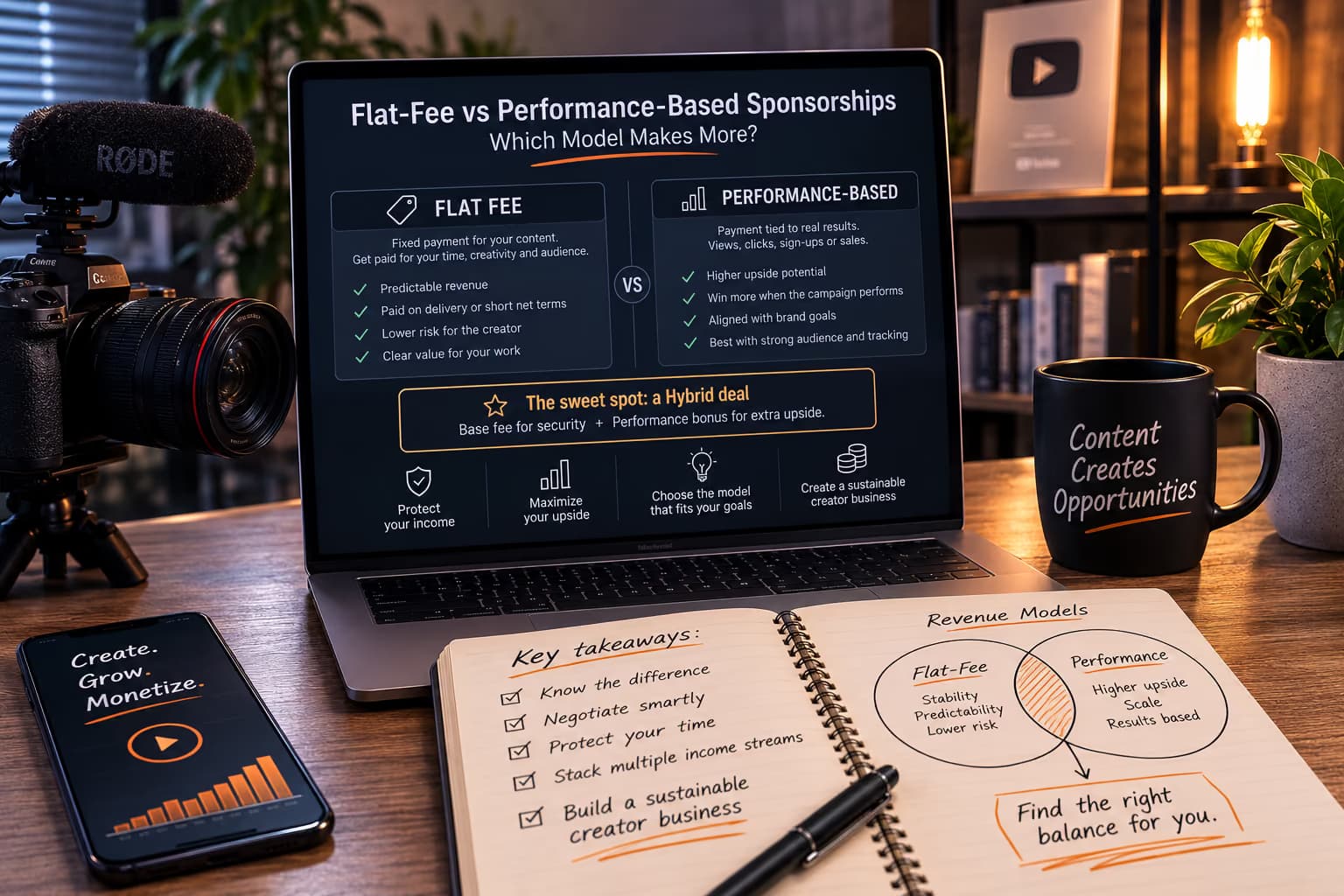
When a brand offers a sponsorship, the pricing structure often matters as much as the headline number. Flat-fee and performance-based deals are not simply two ways to calculate the same payment. They assign risk differently, affect cash-flow timing, and change how much control a creator actually has over the final payout (SponsorCraft).
Understanding the distinction helps independent YouTube (and multi-platform) creators protect their income while still capturing upside when a campaign performs well.
What Each Model Really Means
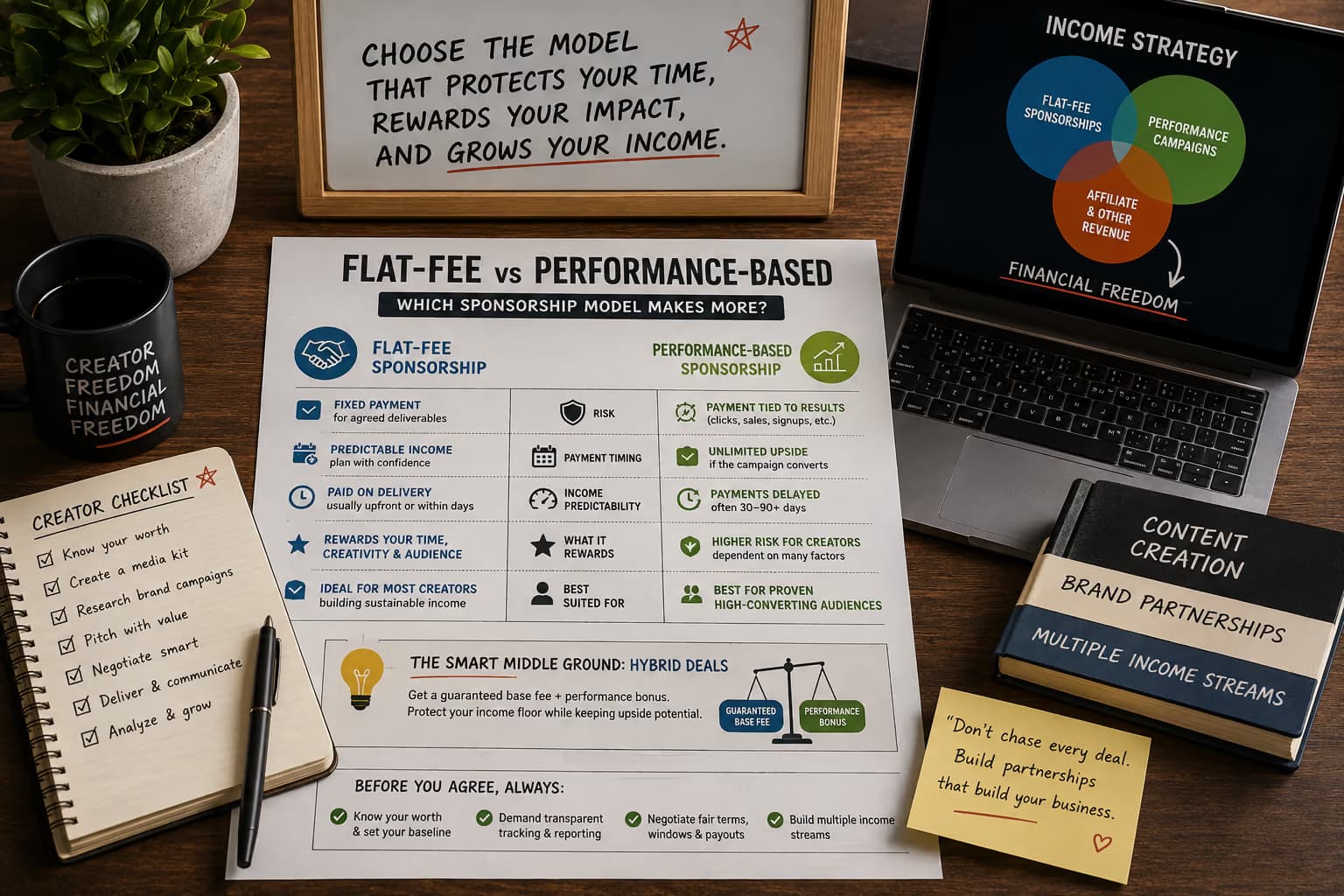
Flat fee. A fixed price for a defined deliverable (integrated mention, dedicated video, Reel package, etc.), paid regardless of post-campaign results. The creator is compensated for time, production quality, and audience access. Performance risk sits with the brand.
Performance-based. Payment is tied, fully or partially, to measurable outcomes after the content goes live—tracked clicks, code redemptions, app installs, or sales. The creator shares outcome risk, often without equivalent control over the offer, landing page, price point, or attribution rules.
| Factor | Flat fee | Performance-based |
|---|---|---|
| Who carries the risk | Brand | Creator (to a large degree) |
| Payment timing | Usually on posting or short net terms | Often 30–90 days after results are tallied |
| Income predictability | High | Low — actual payout can fall well below the pitch |
| Best suited to | Most creators with a defensible rate | Creators with proven high-converting audiences and reliable tracking |
| What it primarily rewards | Reach, production, and audience access | Factors partly outside the creator’s control |
Brands have a parallel choice on how they buy (Flat fee vs pay-per-view). This article is the creator-side cut: which structure you should accept, and on what terms.
Pros and Cons at a Glance
Flat-fee advantages
- Predictable revenue that can be planned against
- Immediate or near-term payment for work already delivered
- Clear valuation of time and audience access
Flat-fee drawbacks
- Upside is capped at the negotiated rate
- Can require more frequent deal-making to maintain income
- Brands sometimes request tighter messaging control
Performance-based advantages
- Uncapped potential if the campaign converts strongly
- Aligns incentives when the product and audience truly fit
- Can work well for evergreen or high-intent niches once tracking is solid
Performance-based drawbacks
- Income is uncertain and often delayed
- Results depend heavily on the brand’s offer, landing experience, and attribution window
- Starting out can feel slow until conversion data accumulates
A $500 flat fee on a post that later does millions of views is a cost-certainty win for the brand — and a ceiling for you (Content Rewards). That is the mechanic, not a moral failing. Price the floor first, then decide whether to sell upside.
Why Pure Performance Offers Need Scrutiny
A brand framing performance pricing as “fairer” is asking the creator to underwrite marketing risk. That can be acceptable when the creator has strong historical conversion data and transparent tracking. It becomes problematic when:
- Metrics are self-reported by the brand with no independent dashboard or tracked link for the creator
- The attribution window is vague (does a conversion 45 days later count?)
- The per-conversion or commission rate sits quietly below category norms
- There is zero guaranteed floor attached to an optimistic projection
In these cases the “bigger opportunity” is a best-case scenario, not a reliable number a creator can pay bills from. If a brand will not share past creator-campaign conversion data, treat the projection as marketing, not a forecast.
The Hybrid Structure Most Experienced Creators Prefer
Many creators avoid choosing one model exclusively. A common and balanced approach is a reduced flat fee plus a performance bonus above a clear threshold. This keeps a guaranteed floor while still allowing strong results to pay more than a pure flat rate (Fintel Connect).
Example structure. Calculate a realistic flat-fee baseline for the deliverable (How to Price Your First Brand Deals). Counter a pure performance pitch with roughly half that amount as a guaranteed base, plus a defined bonus per verified conversion (or percentage) once a threshold is cleared, paid within 30 days.
If the campaign underperforms, the creator still receives meaningful compensation. If it hits the brand’s projection, the creator can finish ahead of both the original flat rate and the optimistic performance estimate. The brand also gains a reason to say yes: they are no longer paying full price purely on faith.
A performance bonus on top of a real flat fee is upside. A performance number *replacing* a flat fee is the brand asking you to underwrite their media budget.
How to Counter a Performance-Only Offer
- Request a base rate plus bonus instead of pure performance.
- Ask for the brand’s historical conversion data from past creator campaigns (not just a projection).
- Shorten the payment and attribution window so income does not sit at risk for 60–90 days.
- If a brand refuses any guaranteed component, that reluctance itself is useful information about their confidence in the offer.
Where Performance Platforms Fit for Independent Creators
Traditional brand performance deals often place most of the downside on the creator. Transparent, platform-mediated performance models can change that equation.
Wayo Ads is designed around validated engagement rather than opaque self-reported results. Creators join campaigns that pay a fixed CPM on verified video or Shorts views, or CPC on tracked links. There is no minimum follower requirement, the platform fee is low and transparent (about 5% — creators keep the large majority), and earnings are tied to measurable, anti-fraud-checked activity.
This structure sits between classic flat-fee sponsorships and pure brand performance offers. It gives smaller and mid-size creators a way to earn from real attention without waiting for high subscriber thresholds or accepting open-ended conversion risk. Many use it alongside flat-fee brand deals and affiliate links to diversify income while keeping predictability (Creator Monetization Beyond AdSense).
Practical Takeaway
Neither model is universally superior. Flat fees protect cash flow and value production work. Performance structures can unlock higher upside when conversion data, tracking, and product-audience fit are strong. Hybrids often deliver the best of both.
Before accepting any performance-heavy pitch, calculate a realistic flat-fee baseline for the deliverable, demand transparent tracking, and protect a guaranteed floor. For ongoing, validated pay-per-engagement opportunities that do not require large followings or long approval cycles, platforms such as Wayo Ads provide a creator-friendly performance layer that complements traditional sponsorships.
Choose the structure that matches your risk tolerance, conversion confidence, and need for predictable income—then stack the models that keep both your creative freedom and your bank account healthy.