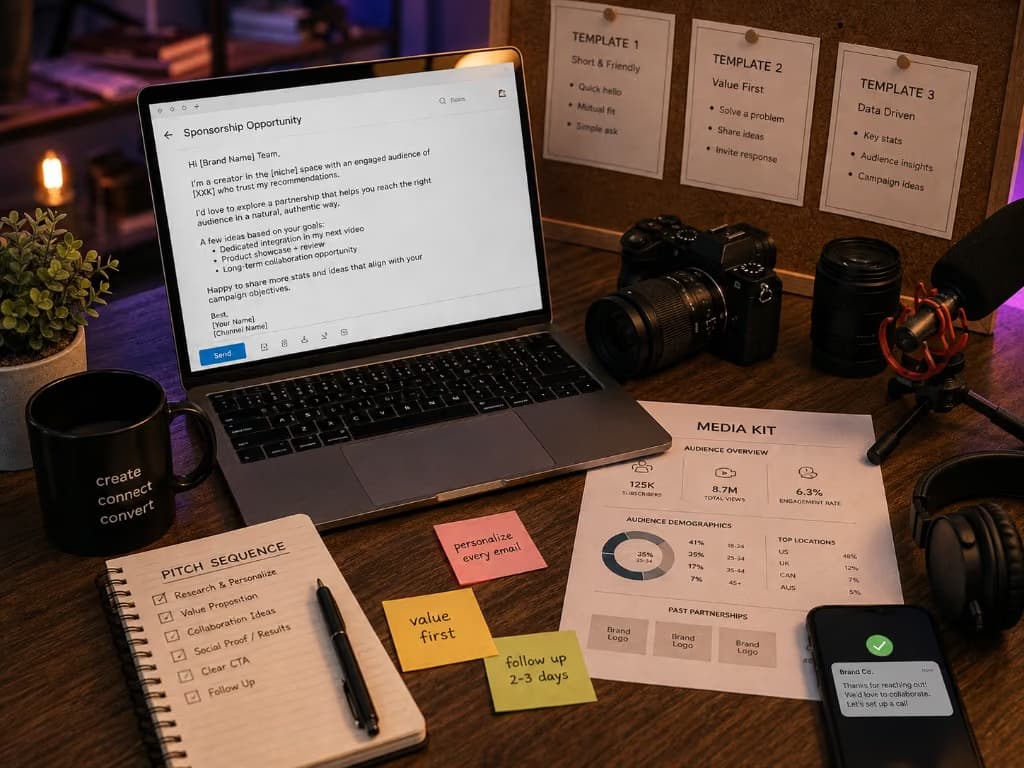
Many independent YouTube creators reach a frustrating middle stage: videos are performing, subscribers are growing, yet paid brand deals remain elusive. Sponsorships are not reserved for massive channels. Brands increasingly work with mid-size and micro creators who demonstrate clear niche positioning, engaged audiences, and professional outreach.
The creators who land deals treat sponsorships as a repeatable skill. They prepare their channel, find the right contacts, send concise value-focused pitches, follow up systematically, and structure deals that protect their earnings. This guide combines practical channel setup, outreach strategy, and ready-to-use email templates so you can start converting conversations into paid partnerships.
What Brands Actually Evaluate
Subscriber count is secondary. Brands primarily look at the same signals covered in What Brands Look for Before Approving a Creator:
- Average views over the last 30–90 days
- Average view duration and retention
- Engagement rate
- Audience demographics and intent
- Niche alignment with their product
- Consistency of posting
A focused finance or software creator averaging 20,000 views can often command higher rates than a general entertainment channel with the same views because the audience is higher-intent. Finance and B2B sponsorships frequently land in higher CPM ranges, while broader entertainment or gaming tends to sit lower.
Make your channel pass a quick “brand manager test.” In roughly 60 seconds someone should understand who you help, why your audience trusts you, and whether a product would fit naturally.
Prepare Before You Pitch
Channel page as a sales page
Clear niche description, organized playlists, professional branding, a visible business email in the About section, and links to other platforms all signal that you take partnerships seriously. Full setup is in Landing Your First Brand Deal.
Media kit
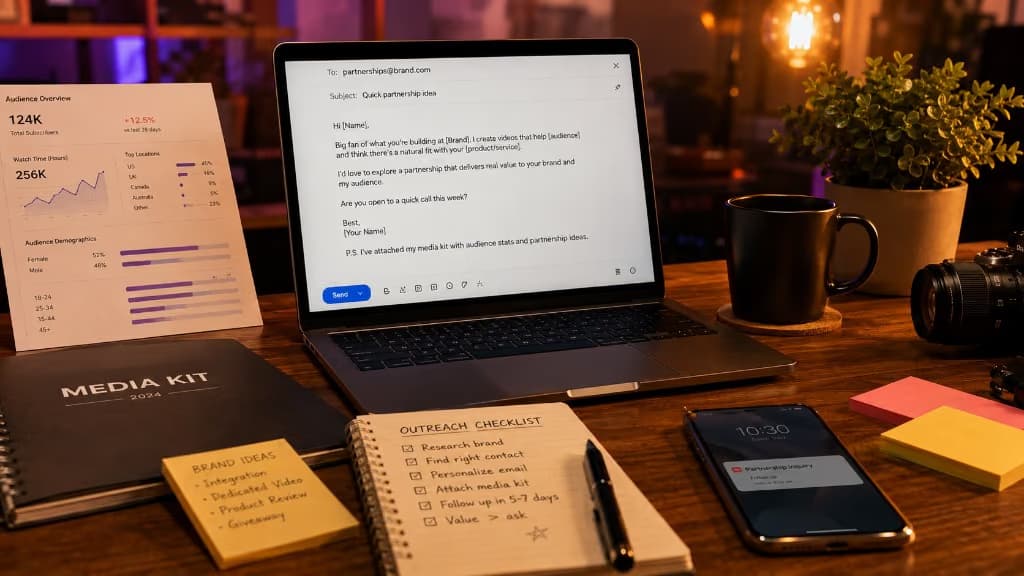
Include a short bio and niche, average views, recent performance, audience demographics, engagement/retention highlights, past collaborations (even small ones), and contact information. A clean one-page PDF removes friction and improves response rates. When a brand replies, the first ask is often the kit — have it ready before you send (SponsorRadar).
YouTube Creator Partnerships and marketplaces
For Partner Program members in supported countries, YouTube Creator Partnerships (inside the Earn tab) uses AI matching. Completing profiles on a few creator marketplaces increases inbound opportunities. Still, direct outreach remains one of the highest-ROI methods because it lets you target any relevant brand and keep full deal value. Email also beats DMs: partnership managers live in their inbox, and a formatted pitch with a media kit link reads as a business proposal, not a fan message.
Finding the Right Contact
Generic inboxes (info@, marketing@) produce very low response rates. Target people who manage creator or influencer partnerships:
- Influencer Marketing Manager
- Brand Partnerships / Creator Relations
- Head of Social or Marketing (especially at smaller companies)
- Founder/CEO at early-stage startups
Use LinkedIn search (company + title), the brand’s partnerships or press page, and email-finding tools when needed. partnerships@ or marketing@ addresses are better fallbacks than generic support emails.
The High-Converting Pitch Structure
Effective cold pitches are short (ideally 100–150 words), specific, and focused on the brand’s needs rather than your subscriber count. High-performing emails follow a clear five-part flow (SponsorRadar uses a similar hook → value → credentials → CTA shape):
- Personalized opening that references a recent campaign, product, or initiative
- Concise value proposition with one or two strong metrics (average views, engagement, key demographics)
- Specific proposal (format, topic, rough timing)
- Optional social proof (past partners or results)
- Low-friction call to action
Subject lines that perform well tend to be specific (“Brand × Channel — quick partnership idea,” data-led hooks, or references to previous organic mentions) rather than generic “Collaboration opportunity.” Avoid “Sponsorship inquiry” and “Looking for sponsors” — they read like spam and say nothing about fit.
Do not talk budget in the first email. The goal is a conversation, not a rate card.
Template 1: Standard Pitch
Subject: [Brand] × [Your Channel] — quick partnership idea
Hi [First Name],
I noticed [Brand]’s recent [campaign/product launch] — [specific observation]. It aligns closely with what my audience cares about.
I run [Channel Name], a YouTube channel focused on [niche] for [audience description]. Videos average [X] views with [Y]% engagement, and the audience is primarily [key demographic].
I’d like to feature [Product] in a natural [integrated mention / dedicated segment] inside an upcoming video on [topic]. Happy to share my media kit with full audience data and rates.
Would you be open to a short call this week?
Best,
[Your Name]
Template 2: Data-Led Pitch
Subject: [X]% of my audience matches [Brand]’s target customer
Hi [First Name],
I surveyed / analyzed my audience of [X] subscribers and found that [Y]% are actively evaluating or using products in [category]. [Z]% specifically mentioned [Brand] or close competitors.
I create [brief content description] and reach [demographic snapshot]. A focused integration around [specific use case] could drive relevant results.
I’ve attached my media kit. Worth a 15-minute conversation?
Best,
[Your Name]
Template 3: Existing Fan / Organic Mention Pitch
Subject: I’ve been recommending [Brand] organically — let’s make it official
Hi [First Name],
I’ve recommended [Product] to my audience over the past [time period] because [genuine reason]. One recent mention in a video on [topic] reached [views].
Since the fit is already there, I’d like to explore a formal partnership. My channel reaches [audience description] with strong engagement on [relevant topics].
Media kit attached. Open to discussing a sponsored integration?
Best,
[Your Name]
The warm version often outperforms a cold one when it is true. “I use [Product] to [specific workflow]” beats “I’m a fan of your brand.” Specificity is the authenticity signal brands look for.
Follow-Up Sequence That Closes Deals
Most deals do not close on the first email. A simple sequence works:
- Day 5–7: Short bump + one new piece of value (recent performance metric or timely idea)
- Day 12–14: Slightly reframed offer or alternative format
- Day 21–25: Final polite close (“floating this one more time before I move on”)
Reply in the same thread. After three touches with no response, move the brand to a revisit list for a later quarter. Track every outreach in a simple spreadsheet so follow-ups never slip.
When a brand replies, respond quickly, attach the media kit if needed, propose concrete call times, and ask about their goals and timeline. Listen first, then tailor the package.
Pricing, Structure, and Delivery
Typical 2026 integrated sponsorship ranges vary widely by niche and performance, but rough subscriber-tier starting points exist. Niche intent matters more than size—finance, software, and B2B often command significantly higher rates than general entertainment or gaming for the same view counts. Dedicated videos and packages (video + Shorts, usage rights, exclusivity) increase value. Unbundle those extras using How to Price Your First Brand Deals.
After delivery, send a brief performance summary (views, engagement, qualitative feedback). Reliability and clear communication turn one-off deals into repeat or retainer work. Brands are shifting toward longer partnerships; after a campaign that lands, propose a multi-video package instead of waiting to be asked.
Stacking Income Beyond Sponsorships
Brand deals are powerful but work best as one stream among several. Many independent creators combine them with AdSense, affiliates, digital products, memberships, and performance-based campaigns (Creator Monetization Beyond AdSense).
Platforms designed for validated engagement give smaller and mid-size creators another reliable layer. Wayo Ads connects brands with creators through performance campaigns that pay on validated video or Shorts views (or tracked clicks), with no minimum follower requirement and a transparent low platform fee (about 5% — creators keep the large majority). It fits naturally alongside sponsorship outreach—especially while you are still building inbound deal flow or want income that scales with real attention rather than waiting solely for brand approvals.
Practical Next Steps
- Update your channel description, About section, and media kit so the value is obvious in 60 seconds.
- Identify 8–12 brands already working with similar creators.
- Find the right contacts and send personalized pitches using the structures above.
- Follow up on schedule and track everything.
- After the first successful deal, package services, suggest follow-ups, and explore complementary performance options such as those available on Wayo Ads.
Landing sponsorships is less about waiting to be discovered and more about clear positioning, precise outreach, and professional delivery. Once the first deals close, the process becomes far more repeatable—and a solid foundation for a real creator business.